


Category
∨
All Categories
All CategoriesdefaultCategory:View All
Bevis Legend (1)Bevis Legend
Burgesses (1)Burgesses
church plate (1)church plate
Common Land (1)Common Land
Documents (9)Documents
publications (1)publications
Ships (1)Ships
Sir Richard Lyster (1)Sir Richard Lyster
Timeline (1)Timeline
Town Officers (1)Town Officers
transcription (1)transcription
Tudor Medicine (1)Tudor Medicine
Tudor Music (1)Tudor Music
Order By
∨
Date PublishedpublishDate
Date PublishedpublishDate
Titlee.article_title
Authoru.user_forename
Direction
∨
DescendingDESC
AscendingASC
DescendingDESC
Bevis Legend
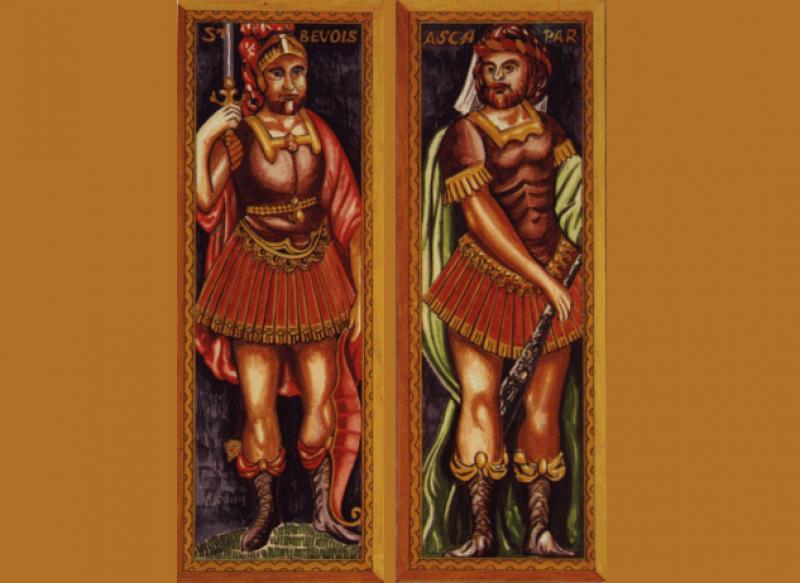
Bevis and Ascupart
Dr Cheryl Butler, May 2012
In late fifteenth century England many towns started to create histories and identities for themselves, drawing on historic sources such as Geoffrey of Monmouth. Bristol created its mythical origins in the time of the ancient Britons, a legend which contributed to Bristol receiving its county status in the fourteenth century. When Henry VII visited Bristol in 1486, he was greeted by its legendary founder King Brennius.[1] Other towns also made links to their legendary past, both real and imagined: Bath with King Bladud, Colchester with King Coil, and Oxford with King Mempricius. Other towns looked to Anglo-Saxon saints and kings such as King Ethelbert at Hereford and Oswald and Wulstan at Worcester.[2] Southampton's legendary founder, Sir Bevis of Hampton, like the more famous King Arthur, appears first in romances of French origin around the time of the Crusades. The first printed version of Bevis's exploits was produced in Venice in 1489, in England when a quarto version appeared it was entitled 'Sir Bevys of Southampton; the Son of Guy Erle of Southampton'. The stories were translated into Dutch, French, Icelandic, Italian, Welsh and Russian and King Henry V ordered tapestries of some of the episodes which he took with him on the Agincourt campaign. Other enthusiasts of the story include Margaret of Anjou, wife of Henry VI, and John Bunyan.
Camden, who produced an early history of England, said that Bevis was a Saxon who, like Hereward the Wake, tried to stem the Norman tide making a stand at the battle of Cardiff in Wales. In one version Sir Bevis returns to England from his adventures and fights his last mighty battle in London against the Italian colony who lived in Bread Street.[3]
Meny Lumbaris he gan mete;
They asayled Beues faste,
On yche side he them down caste.
Sir Beues had bene in many lond,
And meny a batell hath had in hond,
Yet was he nevure so carefull a man
In no batell, as he was thanne
The Romance of Sir Bevis survives in a copy held in the Bodleian Library [Douce B subt 234], the book was manufactured and published by the London printer Richard Pynson c1503, the text is illustrated with many woodcuts. The text is written English from the fifteenth century. In the sixteenth century the book was published at least nine times, and in the seventeenth century six times. The poem is 4,322 lines long and is a romance adventure; it was used as a school text and the Bodleian version has school boy scribbles in the margin one by a boy called John Bettes and a previous owner was Thomas Bettes.[4] It is probable the boys were from Aylesbury from other notes in the book but by coincidence the Bettes family were well known in Southampton in the sixteenth century and John and his five brothers, including Thomas, all attended the King Edward VI Free Grammar School.[5]
The outline of the story is that Bevis's father was Guy, Earl of Southampton, a brave but elderly knight. His mother, a much younger woman, was the daughter of the King of Scotland who wanted to marry the Emperor of Germany or his brother. When Bevis was seven his mother and her lover, Sir Murdour, killed Sir Guy, leaving them free to marry. When Bevis objects, his mother orders his tutor Sir Sabere to have him killed, but Sabere fakes the death and Bevis is concealed working for a while as a shepherd but on his mother's wedding day he returns home and attacks Sir Murdour. Bevis is over-powered and sold into slavery finally ending up in the court of King Ermin of Armenia, where he falls in love with the king's daugher, Josian. This leads to a further period of imprisonment for seven years, where he survives by living off mice and rats. Eventually he escapes and after killing a savage boar is given Josian's hand. Bevis then goes adventuring with his flying horse Arundel, a gift from Josian, and his magic sword Mortglay. Josian, in the meantime, is forced to marry another but maintains her virginity by means of a magic girdle. When yet another man tries to marry her by force, she strangles him with it and nearly gets burnt at the stake. Reunited at last with Bevis she is almost eaten by lions, gives birth to twins alone in a forest, and gets carried away by a giant called Ascupart.
This giant was both might and strong
And fully thirty foot long;
He was bristled like a sow,
A foot [in length] he had between each brow
Bevis tames the 30 foot giant, Ascupart, who becomes his squire and Ascupart is baptised at Cologne. Eventually the trio return to England where Bevis drowns his stepfather in a vat of boiling lead and his mother throws herself off a tower. One of his sons becomes King of Armenia, the other King of England. Bevis, Josian, and Arundel all die in the East on the same day and their sons bury them in a chapel and found a monastery to pray for their souls. The sword Mortglay can still be seen at Arundel Castle.
The stories inspired others, Shakespeare has Edgar quoting from the Romance in King Lear “Rats, and mice and such small deer/Was his meat that seven year” and Shakespeare's patron, Henry Wriothesley third Earl of Southampton, dressed as Bevis in a tournament.
In Southampton in the sixteenth century two, larger than life, oak panel paintings of Bevis and Ascupart flanked the entrance to the town, the Bargate, they were fixed to the outside of the gateway adjacent to two carved wood lions, probably referencing Josian's adventure. It is not known when the paintings first appeared but we do know they were 'new painted' in 1593-4 and at the same time a painting of Queen Elizabeth I was commissioned and set up between the two panels. The lions which had originally cost £4 to make were repainted at a cost of 4s, the painting of Bevis and Ascupart cost £2 5s, with the painter receiving 5s towards his work. Lewis Langley was paid 7s for mending the frames for Bevis and Ascupart and 5s for working on the lions. Lewis Langley was a joiner and was active in the town from 1567, living in the parish of St Michael & St John. William Merryet, the grocer of Holy Rood parish, received £6 7s 6d for gold and colour for the lions and new painting of Bevis and Ascupart. It took two men eight days work to set up the Queen's picture which cost the mayor 10s and 5s for beer.[6]
It is rare to find information on provincial painters, there are two that are mentioned in Southampton documents; Richard Dashewell painted a plot [map] of the town and its liberties in 1570-1 which cost 6s 8d. Dashewell was given two skins of parchment, received a fee of 8d and received 3d for paper, 16d for one and a half ells of canvas and an ell and a half of soultage at 12d and felt, also 12d. At the same time 'the painter' presumably Dashewell was given twenty ells of canvas to paint for the town hall and received £3 14s for his trouble. The other is Henry Matthew, a painter who was working in 1575, nothing is know of his commissions but from a number of inventories of grocers and merchants a good deal of painter's materials were held in stock in the town .[7]
The painting of Queen Elizabeth has not survived but the oak panels have and now reside inside the Bargate.
[1] D M Palliser, 1994, 'Urban Society' in Fifteenth Century Attitudes: Perceptions of Surety in Late Medieval England ed. R. Horrox, p. 148.
[2] Ibid, p. 148.
[3] A Ruddock, 1951, Italian Merchants and Shipping in Southampton 1270-1600, Southampton Records Society pp. 164-5
[4] N Orme, 2003, Medieval Children, Yale University Press pp. 298-302
[5] C F Russell, 1940, A History of King Edward VI School Southampton, privately printed, pp. 52-3
[6] C Butler, 2010 The Book of Fines: The Annual Accounts of the Mayors of Southampton Volume III, 1572-1594, Southampton Records Series, pp. 209, 211-12
[7] E Roberts & K Parker 1992 Southampton Probate Inventories 1447-1575 Volume II. p. 428
Published:
26th May 2012 22:47
Author:
Cheryl Butler
LATEST ARTICLES
How many wives had Richard Lyster?
most biographies of the Lord Chief Justice of England have him married to the wrong women Read on...


